Pretty
rich_gradient.Pretty wraps rich.pretty.Pretty so structured Python objects (dicts, lists, dataclasses, and so on) are printed with a gradient across the formatted output.
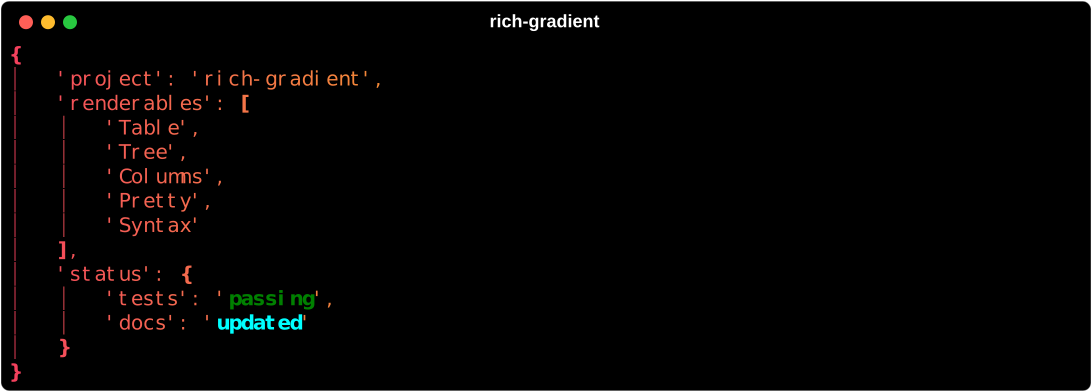
Basic usage
from rich.console import Console
from rich_gradient import Pretty

console = Console()
payload = {"project": "rich-gradient", "status": {"tests": "passing"}}
console.print(
    Pretty(
        payload,
        colors=["#f43f5e", "#f59e0b", "#22c55e"],
        indent_guides=True,
        expand_all=True,
    )
)
Pretty options
The arguments Rich's Pretty takes are forwarded:
indent_sizeandindent_guides: indentation width and guide lines.expand_all: expand every container onto multiple lines.max_length,max_string,max_depth: abbreviate long containers, long strings, and deep nesting.highlighter: a custom Rich highlighter.pretty_justify,overflow,no_wrap,margin,insert_line.
from rich_gradient import Pretty

Pretty(
    {"items": list(range(100)), "name": "x" * 200},
    max_length=5,
    max_string=20,
    rainbow=True,
)
The underlying Rich object is available as pretty.pretty.
Highlighting values
from rich_gradient import Pretty

Pretty(
    {"tests": "passing", "docs": "updated"},
    colors=["#f43f5e", "#f59e0b", "#22c55e"],
    highlight_words={"passing": "bold green", "updated": "bold cyan"},
)
Shared gradient options
Like every Gradient-based wrapper, Pretty accepts:
colors/bg_colors: foreground and background color stops (CSS names, hex, RGB tuples, orrich.color.Color).rainbowandhues: generate a palette automatically (huesis at least 2).repeat_scale: leave it unset and one pass across the output runs from the first color to the last. SeeGradient.justify/vertical_justify/expand: position the output inside the gradient frame.highlight_words/highlight_regex: extra styles applied after the gradient pass.console: a specific RichConsoleto render with.
For the full signature see the Pretty reference.