Rule
rich_gradient.Rule wraps a rich.rule.Rule (via the Gradient base class) and applies gradient color stops (foreground and optional background) across the rule glyphs. Alignment and title options mirror the Rich rule.
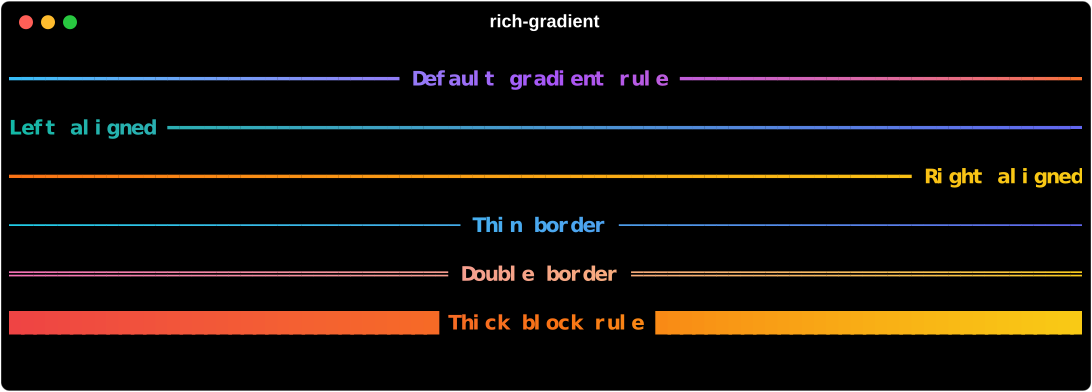
from rich.console import Console
from rich_gradient import Rule

console = Console()
console.print(Rule("Default gradient rule", colors=["#38bdf8", "#a855f7", "#f97316"]))
console.print(Rule("Left aligned", align="left", colors=["#14b8a6", "#6366f1"]))
console.print(Rule("Right aligned", align="right", colors=["#f97316", "#facc15"]))
console.print(Rule("Thin border", thickness=0, colors=["#22d3ee", "#6366f1"]))
console.print(Rule("Double border", thickness=2, colors=["#f472b6", "#facc15"]))
console.print(Rule("Thick block rule", thickness=3, colors=["#ef4444", "#f97316", "#facc15"]))
Thickness and alignment
align:"left","center"(default), or"right".thickness: integer 0-3 controlling the glyph (─,━,═,█respectively).characters: provide your own glyph when you need full control.
The gradient is distributed across the rendered width after padding and indentation are applied.
Rule uses the same cell-aware rendering path as Gradient, so highlighted titles,
wide glyphs, combining characters, foreground gradients, and background gradients are
handled consistently.
Titles and colors
Rules support title and title_style, and the rule's placement is controlled by align. Styles can reference any color supported by rich.color.Color, including CSS names and hex codes provided by rich-color-ext. Pass bg_colors to paint the rule background.
The example script that generates the gallery is saved as examples/rule_gallery.py.